The Light Does Not Hurry
A sunset at Rialto Beach in 2012, and the Olympic Peninsula I call home: its rain, its rock, the peoples who stayed, and the light that does not hurry.
August 4, 2012. Rialto Beach, on the Olympic Peninsula.
I had come back from Uganda in January, gone to Germany in March, and come home again in April to finish my master's thesis and defend it. By August, I was done. So I drove out to Forks to visit a friend.
Another friend came along, and so did my dog, Ranger. That evening we drove down to Rialto Beach to watch the sunset, take some photos and video, and let Ranger stretch his legs. It's a popular spot, and for good reason.
I've said for a long time that wherever I go, I will die on the Olympic Peninsula.
It's not where I was born, and I've lived other places longer. But when I'm on the peninsula, I feel most at home. Most connected to the place. It will always be home, as much as I have one.
Green
We moved to the peninsula from Southern California when I was a kid. We lived on the northeast side, near Bremerton. I couldn't get over how green it was. I never thought much about the rain.
There were trees behind our house, and I used to disappear into them for hours. I rode horses and hiked the trails that run all over that country. In high school, I used to stare at the Olympics through the window of my economics classroom and wish I were out in the forest.
Mountains that were seafloor
I've seen the peninsula from every side since. It's a country of its own: mountains in the middle, rainforest to the west, cold salt water on three sides.
Look east and the Cascades stand up sharp. The Olympics feel older, their lower slopes worn and rounded. Much of their rock began on the ocean floor, scraped off and folded upward as the seafloor slid under the edge of North America. Then glaciers carved them through one ice age after another. The last great ice sheet split around the Olympics, one lobe flowing toward the Strait of Juan de Fuca and another down what is now Puget Sound. By about fifteen thousand years ago, the ice was retreating.
The mountains are still changing. Just not at a pace anyone could watch.
The rain
The mountains make the rain. Wet air comes in off the Pacific, hits them, and lets go. On the west side, in the Hoh, Queets and Quinault valleys, that means twelve to fourteen feet of rain a year.
That rain makes temperate rainforest, one of the rarest kinds of forest on earth. It grows along the Pacific coast from northern California to Alaska, and in only a few other places, like southern Chile and New Zealand.
Sitka spruce and western hemlock fill the valleys, and some grow more than two hundred feet tall. Moss hangs off the bigleaf maples. New trees grow in a line along the back of a fallen one, rooted in the wood that once held another tree up.
The rain feeds this forest, and so does the sea. When salmon come up the rivers to spawn and die, the nutrients they carried from the ocean end up in the soil and the trees along the banks.
The forest feels old, wild, and wise.
The people who stayed
People have lived here for thousands of years. The Quileute and the Hoh on the outer coast, the Makah at the northwest tip, the Klallam along the strait, the Quinault to the south, and other peoples across the peninsula have long relationships with these lands and waters.
The coast gave salmon, shellfish and marine mammals. The forest gave cedar. Western redcedar splits into long, straight planks and holds up in the wet. People made longhouses, canoes, baskets, clothing and rope from it.
This wasn't just survival in a hard landscape. Many coastal communities lived in permanent villages, stored food through the winter, traded with their neighbors, and built deep traditions of art and ceremony. At a potlatch, wealth was given away, and in the giving, relationships, rights and standing were affirmed.
Abundance meant more than having enough to eat. It made room for all of that.
They're still here. The Quileute, Makah, Hoh, Quinault and Klallam are nations today, and the coast is still theirs to speak for.
Newcomers
Then another people moved into the range. They wanted what everyone here had always lived on: the land, the timber, the fish. Treaties were signed, lines were drawn, and the people who had been here longest were pressed toward the edges.
The newcomers learned from the land, and from the people already on it. They built with cedar, and cedar shingles and siding are still the look of the Northwest. They learned to cook salmon on a wooden plank beside the fire. In some places, burning had helped keep prairies open; when the burning was stopped, the forest grew back into them.
And they cut the forest. For much of the twentieth century, logging drove the west side of the peninsula, and Forks was a timber town. Then the ground shifted under them, too. After the northern spotted owl was listed in 1990, the harvest on federal land fell sharply, and mills closed.
Quileute country
Rialto Beach lies within Olympic National Park, near the mouth of the Quillayute River. Across the river is La Push, the Quileute village. This stretch of coast is Quileute homeland, though the lines on a modern map divide it between different jurisdictions.
The ground here moves, too. On a winter night in January 1700, a great earthquake off this coast sent a tsunami across the Pacific. It reached Japan, where it was written down as a wave with no earthquake to explain it. Scientists eventually traced it back here. Quileute and Makah stories tell of a great shaking and flood that many link to it.
Farther north, near Cape Alava, Makah ancestors carved figures into the rocks at Wedding Rocks. The coast is old human ground. Its stories don't begin with the park, the state, or the country.
The light
Much of that coast is still tribal homeland, or park, or both. And the light there does not hurry.
That evening at Rialto, I wasn't thinking about any of this. I was watching the light.
The video I took that night is a single slow pan: a sea stack with trees on top, the sun flaring behind it, a long forested headland, rocks and surf in front. Nothing more than that. Ranger was there. My friends were there. But for me, it's a memory of a home I once knew, and love dearly.
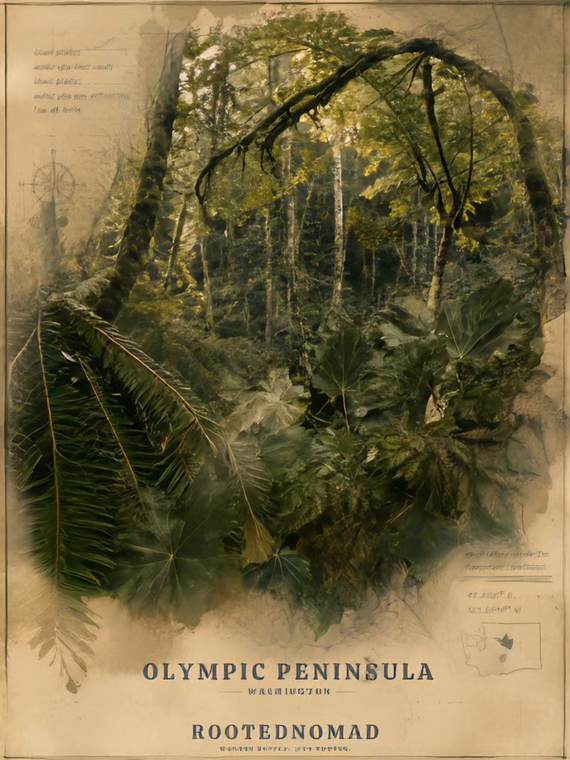
The Olympic Peninsula became a print: Olympic Peninsula, limited edition.
Keep up to date on RootedNomad Observations
New observations, delivered to your inbox. No spam. Unsubscribe anytime.