Free the Feet
In 2015, a few months before moving to Tanzania, I drove the Southwest to photograph Garden of the Gods. On what makes a trip an expedition, where the word comes from, and why I give each one a number.
In 2015, a few months before I left for Tanzania, I took a road trip through the American Southwest. The North Rim of the Grand Canyon. Canyons of the Ancients. Four Corners. Garden of the Gods.
Each stop had its own objective.
At Garden of the Gods, the objective was photos of a special place on Earth. A place that felt magical. A place that exists in the United States. Someplace I could show people in other places when talking about my country of citizenship.
I was about to move to the other side of the world. I wanted to bring that place with me.
Three kinds of travel
In my life, travel is life. But not all of it is the same.
Just moving is just moving. A flight, a bus, a commute. You go from one place to another.
An adventure is something fun, with a little of the unknown in it. I can go on an adventure to go camping, or to climb a mountain, or to make a quick trip to a place I've never been.
An expedition is a planned trip with an objective. I'm going to this place, for this reason, for this long. In the process, I will bring something back: information, knowledge, a specific experience, or a practical thing.
These aren't separate boxes. An expedition can be an adventure, and an adventure can take a lot of planning. The difference is what I'm setting out to do.
The same mountain can be either. Climb it for the fun of it, and it's an adventure. Climb it to bring something back, and it's an expedition. The difference isn't the activity. It's the objective.
Free the feet
Expedition comes from the Latin expeditio, from expedire: to make ready. Its oldest sense was to free the feet from fetters. To get loose from whatever holds you, and get ready to go.
That road trip was an expedition. I knew where I was going, why, and for how long. And I knew what I wanted to bring back.
The old expeditions
The word has a long history in the American West.
In 1804, Thomas Jefferson sent Meriwether Lewis and William Clark west from St. Louis, with a group called the Corps of Discovery. Their objectives were to find a water route to the Pacific, map the land, record its plants and animals, learn about the Native nations they met, and strengthen the United States' claim to the West. They were gone more than two years. They came back with maps, journals, and specimens.
Much of what they mapped, they learned from people who already lived there. Sacagawea traveled with them. Native guides described rivers and passes, and sometimes drew them, and that knowledge found its way onto the expedition's maps.
In 1806, the army sent Zebulon Pike to explore the headwaters of the Arkansas and Red rivers, along the edge of Spanish territory. In Colorado, he saw a mountain he tried to climb and never reached the top of. He wrote that he believed no human being could ever reach its summit. It carries his name now: Pikes Peak. Garden of the Gods sits at its foot.
In February 1807, Spanish soldiers found Pike and his men at a stockade they had built near the Rio Grande, in territory Spain claimed, and took them south.
By my definition, those were expeditions. A place, a reason, a length of time, and something to bring back.
What they brought back also opened the way for others. Settlers followed the maps. So did the army, and later the railroads. The lines on those maps were drawn across land that people already lived on.
The people who lived there didn't need their home discovered. They already knew it. The expeditions turned that knowledge into something others could use.
My objectives are smaller. A set of photos. Memories to carry. But I think about that history when I bring something back. I can photograph a place. I don't own it, or its history, or what it means to the people who were there first.
That's what I hope my own expeditions show. Not a route to follow, but a way of going. To go somewhere with a purpose, and bring something back, without claiming anything. The place should be no less itself when you leave.
Expedition 1251
Garden of the Gods was a crossing place long before it had that name. The Ute and other nations traveled through it. In 1859, two surveyors came through. One thought it would make a fine beer garden. The other said it was a place fit for the gods. His name stuck.
Charles Elliott Perkins, a railroad man, bought much of the land and wanted it kept for the public. He died before he could give it away. In 1909, his children did it for him. They gave it to the city of Colorado Springs on one condition: that it stay free and open to everyone. It still is.
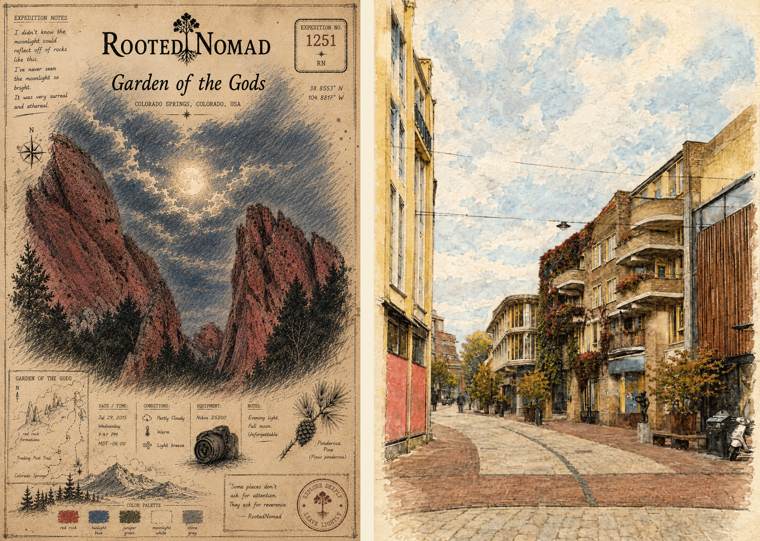
That's the place I photographed. Those photos became Expedition 1251.
I give each expedition its own number, its own place, and its own record. The photographs belong to that trip alone. Nothing from another place gets mixed in. Each set has a log: where I went, why I went, and what came back.
Expedition 5105
This October, I went to Europe for family and professional reasons. Arnhem was part of that trip.
I walked streets I had walked for three years, and wrote: De straten zijn hetzelfde. Ik niet.
Those photos became Expedition 5105.
Different place. Different reasons. The same kind of travel. In 2015, I was leaving, and wanted to carry a place with me. In 2026, I was returning, and found out what a place still carried for me.
The camera is just one way of bringing something home.
Travel is life. Some of it is just moving. Some of it is adventure. And some of it is an expedition: a place, a reason, a length of time, and something to bring back.
Keep up to date on RootedNomad Observations
New observations, delivered to your inbox. No spam. Unsubscribe anytime.